Robin Williams is one of the most recognized names in cinema
due to his involvement in Jumanji, Night at the Museum, this list goes on and
on. One of his films, Dead Poets
Society filmed in 1989, has touched many people of different backgrounds. The
film takes place at a prestigious private school for young boys where the new
unconventional teacher Mr. Keating (Robin Williams) has begun to teach English
for the academy. Mr. Keating is a unique type of teacher who chooses to stray
from the traditional education path that many of his colleagues have taken.
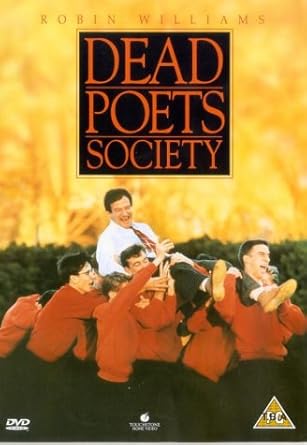
Traditional education as portrayed in the film is teaching
students through strict discipline and compliance to the system focused on
training students to absorb the material they are being taught. In a way the
traditional teaching way is meant to teach students to not question authority
and instead accept authority, the rules, and to conform with the way things are
and have been. The alternative and unconventional teaching methods were opposite
of the traditional. The students, as Mr. Keating portrayed, were free to think
for themselves, question authority, and to be individuals.
One of the most memorable aspects of the film itself was the
unconventional teaching methods that collided with the traditional teaching
methods accepted by the faculty at the school. Both methods attempted to yield
different outcomes for what “success” means to various students. One of the
questions the film poses for the audience is the following: Does conformity
equal success?
Conformity in the film is an important area of interest. In
an early scene, the students are seen reciting the school mantra “Tradition,
Honor, Discipline, and Excellence”. In a way, the students are portrayed as
robots, monochromatic by the same color of their uniforms, and extremely bored
by the sound of their dull voices. Their
entire education in this school, by the cinematic portrayal of this scene, is
meant to be the same because in this “training” they all share the same concept
of what success is, which the teachers and parents identify as being an
academically strong student, getting into an Ivy League school, and obtain a
great job.
Defying conformity is also prominent, in an early scene
where Mr. Keating introduces himself on the first day, the students learn to
view life through a different angle by standing on their desks. He then has one
of them read from the first page of their poetry page which attempts to
mathematically graph good poetry from bad poetry. To express his disdain to
this concept, Mr. Keating has the students tear out that page and many more.
The students hesitate since the idea of ripping pages out of a textbook is
almost “taboo”, but eventually the students begin to enjoy it. This scene also introduces the idea of career
aspiration such as Doctors or Lawyers and introduces the students to the
importance of other aspirations such as artistry, poetry, and passion. In its
own way, society labels medical and legal careers as superior to artistry, Mr.
Keating did not attempt to destroy that idea rather he intended to show them
that there is more to the world and themselves than being doctors or lawyers.

(A picture of a scene where Mr. Keating teaches the students to look at life and learn through a different perspective in order to defy the ordinary)
The film also introduces the good side of conformity by
introducing the father of Neil Perry. Neil wanted to be an actor, but his
father would not allow it and wanted his son to pursue a “real” career.
Conformity in this sense was needed as his family was not wealthy and his
father only wanted his son to have the financially stable future that he did
not. This kind of conformity was honorable and necessary for the family.
Mr. Keating was an anomaly at the school who challenged his
students to think beyond what is expected of them and to find their own
expectations of themselves. Conformity, in my opinion, does not equal success.
Traditional teaching methods do not work for all students and should not be
modeled to make everyone alike. In an essay titled “Reclaiming the Social:Pedagogy, Resistance, and Politics in Celluloid Culture”, Henry Giroux argues
that the culture of the school does not expect the students to know how to
think on their own but rather the parents and faculty there create a culture
where the students are expected to be members of the elite. In other words,
they are expected to be powerful, privileged, and wealthy leaders of tomorrow.
Mr. Keating, disrupts that culture by introducing free thought to the students.
Being the minority amidst an entire body of faculty and parents who disagree
with his unorthodox teaching practices, Mr. Keating ultimately does not last
long in the school.
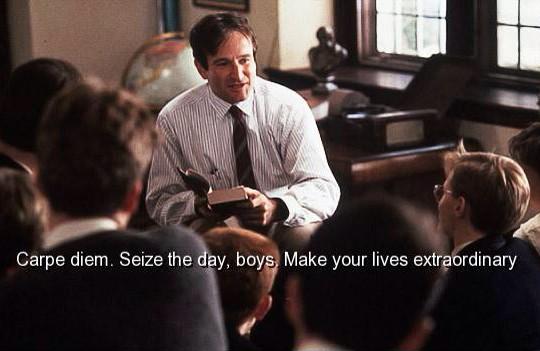
The phrase Carpe Diem or
Seize the Day, frequently used by Mr. Keating is unorthodox and goes against
the conformist views of the school and parents. Carpe Diem refers to the spontaneous, and the students are
encouraged to worry less on the future and live in the present thus stating
that success is only limited to what you allow it to be. Giroux also states
that the older generation and the younger generation have different views on
what success truly means when interpreted by both. This is true because the
older faculty are only focused on teaching their way to the students, any other
way is unacceptable. Because of this, the students never considered the idea that there may be different ways to do something, to be successful, or to learn.
Does conformity equal success? The answer is no but yes. There
are many ways in which one can view conformity as a terrible ideology yet in
the case of Neil Perry’s father, conformity was essential for him and his
family to succeed. I think today in our day and age both traditional and
alternative teaching practices are acceptable and can be understood. Both ways can
lead to success. No student is identical,
and some are more similar than others. Essentially, success is subjective and
teaching to bring out individuality is possible just as teaching conformity is
possible as well.


