Showing posts with label Alex Giangreco. Show all posts

Monday, May 7, 2018

Blog Post 4 Resubmission: If You Can't Stand the Heat: The Cold War, the Kitchen, and Ray Bradbury by Alex Giangreco


Sunday, April 15, 2018

Post 2, Group A (Resubmission): Full Metal Jacket: A Narrative on Suicide

Stanley Kubrick's 1987 Vietnam War classic Full Metal Jacket was one of many films of the era to tackle the conflict in Southeast Asia. This film manages to stand out, however, for several reasons. There are the painfully slow, agonizing combat scenes. Kubrick also presents a stark examination of American Imperialism. I believe, however, that the success of the film hinges on its unique portrayal of a particular setting and story.
   Kubrick essentially made two movies. One about his characters shedding their youthful innocence and becoming trained killers, and all of the psychological and physical burdens they must bare throughout this transformation. Another about the trauma and destruction of warfare, and the moral conflictions of the soldiers. We will focus on the first half of the film, undoubtedly the most recognizable portion.
   The setting is Boot Camp. Combat training is not often depicted in war films, and even more rarely to such an extent. A mixture of bright-eyed, eager enlistees and apprehensive and fearful draftees are thrown into the fire, subject to both physical and mental conditioning. The hard edged drill instructor, Sergeant Hartman, is one of cinema's most memorable characters. The scenes with the actor and veteran R. Lee Ermey ripping his recruits hearts apart with wildly creative insults are what most people recall about this film. This constant degradation, paired with the physical fatigue of military schedules and conditioning makes for a nightmarish environment that drives one recruit, Private Leonard Lawrence, past his breaking point.

   This is where we will transition from setting to story. Private Lawrence, played by Vincent D'Onofrio, is a large man with a low level of intelligence. This leads to a series of mistakes, and creative insults and punishments from Sergeant Hartman. This cycle begins to have a noticeable impact on Lawrence's behavior. The constant berating and physical punishment begin to make him distant amd self loathsome. He is at one point nick named Gomer Pyle, on account of his inability to follow instruction consistently. This verbal abuse only aids in his alienation.
   After hiding a jelly donut in his footlocker and being caught by Sergeant Hartman, Lawrence is forced to watch his squad mates do push-ups as punishment for his indiscretion. This method of punishing the group becomes Sergeant Hartman's preferred method of punishing Lawrence.
We take a break from the film here to consult an article from the Journal of Clinical Psychology from 2010 by Craig Bryan, Kelly Cukrowicz, Christopher West, and Chad Morrow entitled "Combat Experience and the Acquired Capability for Suicide." We learn here of psychologist Thomas Joiner's Interpersonal-Psychological Theory of Suicidal Behavior. This theory consists of three variables, but for now we'll restrict our focus to the first two. These are perceived burdensomeness and thwarted belongingness. Perceived burdensomeness, as described by our authors, is, "the sense that the individual is a burden to others, does not contribute to the group, and is a liability to the group's well-being or safety." (pg. 1045) Thwarted belongingness is defined as, "the sense that the individual lacks important connections to others and that previously meaningful relationships have been strained or lost." (pg. 1045)
   All three variables are said to need to be present for an individual to take their own life. These first two refer to the development of the motivation to do so, and speak to the construction of suicidal thoughts. When referring to the story of Private Lawrence we can see the slow and arduous development of these two variables.
   The punitive practices of Sergeant Hartman, such as forcing Lawrence to eat the donut while his comrades were punished, served to reinforce a feeling of isolation and lack of unity for Lawrence. Lawrence was already beginning to feel like a burden to the team, due to his inability to complete tasks properly, if at all. This is his percieved burdensomeness.
  One scene depicts the unit beating Lawrence in his sleep with bars of soap wrapped in socks. Not only did the unit as a whole make it clear how much of an outsider he was, his only ally, James "Joker" Davis, also participated. Lawrence now feels the sense of thwarted belongingness.
We can see pretty clearly Lawrence's budding motivations for committing suicide to escape the tortures and trauma of training. But what is there to say regarding the capacity to carry out this fearful action? This is where we encounter Joiner's third variable. After percieved burdensomeness and thwarted belongingness take hold, this individual can gain what Joiner calls the acquired capability for suicide. This is, "the degree to which an individual is able to enact a lethal suicide attempt." (pg. 1045)
   The violence enacted upon Lawrence by his peers, superiors, and the training itself desensitized him so much to the thought of death that he acquired this suicidal capability. His only proficiency throughout his training, marksmanship, instilled the confidence to commit such an act. As our authors state, "Because a lethal or near-lethal suicide attempt is extremely fear-inducing and often pain-inducing, habituation to the fear and pain involved is a prerequisite for serious suicidal behavior." (pg. 1045)
   Lawrence's training and abuse broke down his fear of death or pain, and his abilities with a firearm gave him a tool.

 Kubrick documented a maddening and frightful descent into madness, and ultimately death. Private Lawrence is found by Joker in the latrine late one night just before deployment to Vietnam. There he finds Lawrence with an assault rifle, loading the magazine, referencing the ammunition type that lends its name to film's title. Lawrence kills his tormentor, Sergeant Hartman before turning the weapon on himself.
   Private Leonard Lawrence was shown to have exhibited all three of Joiner's variables for suicide. This depiction is raw and apparent. Set against the backdrop of military combat training , the story finds unique footing in the genre, making Full Metal Jacket a timeless war classic.

Museum Bonus: Alex Giangreco


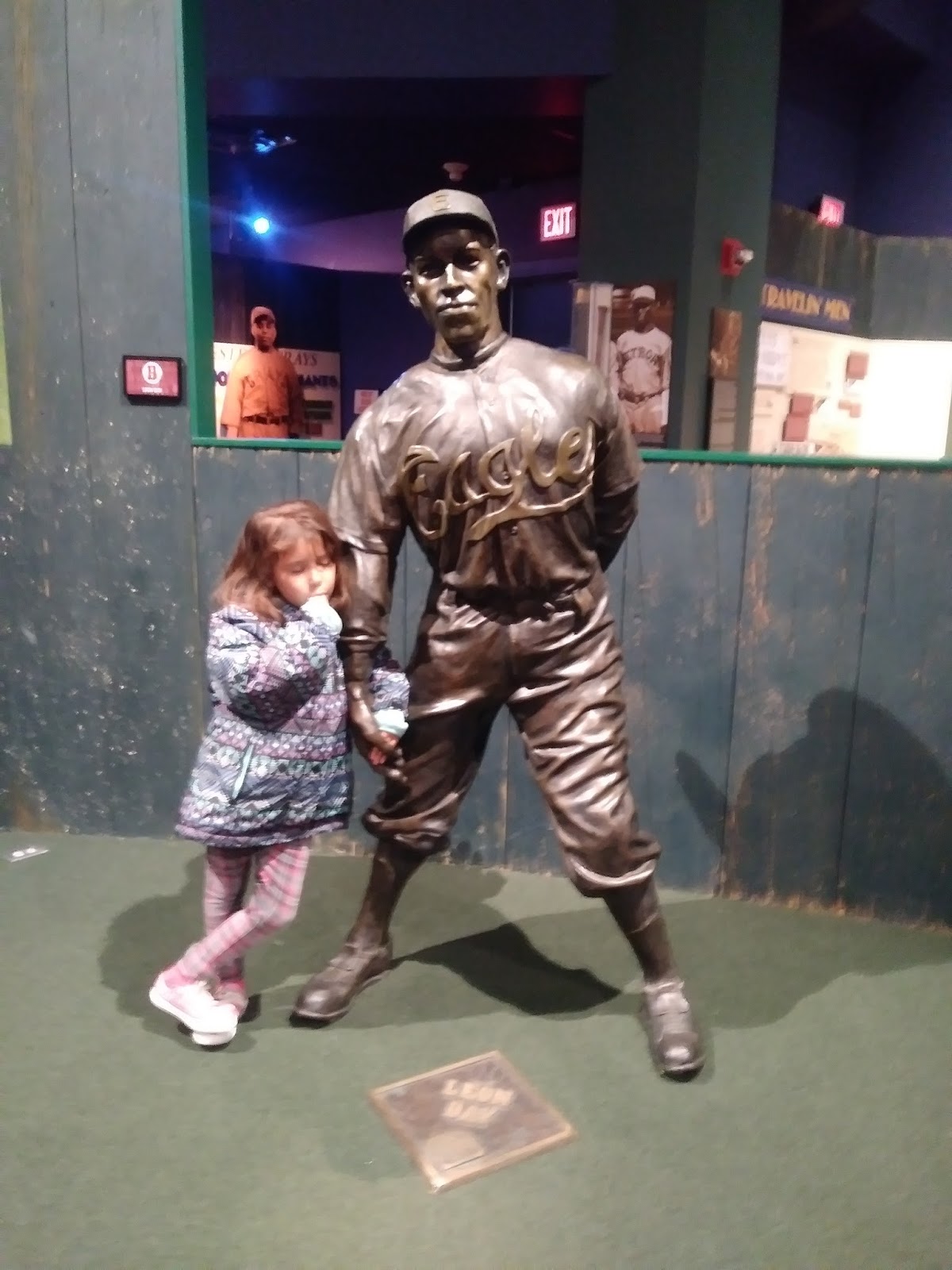
  I visited the Negro Leagues Baseball Museum in the 18th and Vine district, because I have a membership and that made this post a no-brainer. One of my major interests is baseball, specifically baseball history. The most fascinating era of baseball for me is the Negro League era, for two reasons. They played a style and brand of baseball that is unique to that time and circumstance, one that would change the game at the Major League level forever. They played for the love of the game, and nothing more.
    For decades there was no uniformity in compensation. Players on the winning squad would split the take from ticket sales with the venue, and the loser went home hungry. They would play doubleheaders in almost every town, sometimes even more than that. Even winning didn't gaurantee pay. Even pay didn't gaurantee food or accommodations. It was a life lived on the road, not just out of neccesity of schedule, but because of hostile environments for black men during Jim Crow. They were forced to develop of a kind of Underground Railroad, a network of businesses and families known to help. 
Knowing that their performance was their pay, these players developed a hard-nosed but flashy style of play. The more butts in seats, the more take home pay at the end of the game. Satchel Paige would be the most notable of larger than life characters, famous for his taunting behavior towards opponents and interactions with fans, but he was far from the only one. The entire league played fast and pretty in the field and on the base paths. You couldn't just be good. You had to look good, too. This extended to the clothing the fans wore to ballgames, dressing up in their Sunday's best for each game.
 I grew up hearing stories about players like Cool Papa Bell, Roy Campanella, Josh Gibson, Minnie Minoso, and Double Duty Radclife from my grandfather who used to go to Monarchs games when Municipal Stadium still stood at 22nd and Brooklyn.  As a kid, those stories made those guys sound like comic book superheroes.
One of the players my grandfather would talk about most was a pitcher by the name of Hilton Smith for the Monarchs. Hilton and Satchel Paige were the most feared pitching duo in either of the Negro Leagues. They were both tall, aggressive, multi-tool pitchers. Satch became the famous one for his antics on field, but he could be taken advantage of that way. Hilton was a quiet man, all business, and very hard to find a weakness in. Hilton Smith was instrumental in the Monarchs dominance, but even today he remains a very little known name, despite having possibly the best record in Negro Leagues history. (Statistics were never properly kept, but what we do have shows he rarely lost.)

Players would supplement their meager incomes by playing exhibition, or barnstorming, games. This eventually lead to the export of players to Central and South American countries during winter months. To begin, the Negro League players were paid much less than their white MLB counterparts in these Latin Leagues. Simply because they knew the Major Leaguers there. Before long, the black players began to show they were worth the same pay, and they got it. Think about that. These men had to leave the country just to get the same pay and food as the white players they proved they could beat back home in exhibition games. Check the qoute in the picture for an idea of how differently they were treated South of the border.

Countries like Mexico, Cuba, and Venezuela became hotbeds of baseball talent, attracting the best white and black American players, professional Latino players, and even professional players from Asia, all playing side by side. This undercurrent of talent is what lead to desegregation in the MLB. Certain owners and managers began recognizing the talent at home and abroad. Latino players actually integrated first, but they were always light skinned and usually had their names changed. But those superficial restrictions needed to fall if owners really wanted to win ballgames and cash in. The games played in South America remain the stuff of legend, but it is often glossed over. This museum does a terrific job of explaining this era and it's value to the development of the game.


Monday, March 12, 2018

Group A, Post 3. Behind the Blinds: Indirect Love Triangles and Fear of Intimacy-Alex Giangreco

   Some of the most fearful endeavors we undertake in this life are romantic in nature. Fear permeates every stage of intimacy in our romantic relationships. Fears of rejection, vulnerability, and judgement are common in the infancy of any romantic involvement or pursuit. As relationships mature and progress these fears do not subside. Individual fears of mistrust, manipulation, communication, and infidelity impact many relationships in their later stages. The prospect of ending a relationship is also rather terrifying in many instances, as contemplating what comes next and how to move on can add another layer of fear.
   These intimate relationships are inherently frightening for many, due to their fears of repeating past experiences or trauma. A couple can thrive or break due to their responses to these fears. These fears are manifested in our actions, desires, preferences, and behaviors. Our involvement with these factors in a romantic context forms a triangulation. A relationship between the variables and the two parties forms an emotional geometry that can be harmful or beneficial. This triangulation can be healthy and encourage developement, enabling couples to communicate and resolve conflict. Or this triangulation can be a detriment, preventing a couple from properly connecting or engaging.
   I will explore the indirect romantic triangulation existing beneath the surface of the direct sexual triangulation depicted in the Clear Plastic Masks song "Behind the Blinds," released in 2016. I will utilize this analysis to display how triangulation can occur in an intimate relationship. I will also argue that each member of the couple can exhibit their own form of triangulation within the broader context of the relationship's triangulation.

   Defining a love triangle is tricky, so a broad definition serves us best here. Love triangulation is simply our relations to our internal and external worlds, and how they factor into the health and balance of our intimate relations. Triangulation can involve relationships to friends, family, or co-workers. It can also involve hobbies, parental duty, professional obligations, and even ideology. This triangulation can even occur internally due to self-criticizing or self-adulation.
   We tend to consider extramarital or romantic affairs when confronting this topic. This involvement of a third romantic party is referred to as direct triangulation. What is much less identifiable is how our interactions with our fears of intimacy can form a love triangle. This is known as indirect triangulation. How our emotions, desires, behaviors, and needs are approached and addressed in a romantic context, and how that complexity impacts the couple's interactions.
   In the opening verse of the song we can easily identify that some sort of triangulation is at play in this relationship. We cannot yet identify whether it is direct or indirect, but one party is obviously allowing an external force to impact their involvement in the relationship:
   "Well, the sun finds me hiding behind the blinds. Rolls me over like the change in tide. Though your memory will eclipse, eclipse the day, all that's left is your lipstick on the filter tip in the ashtray."
   So, the woman in his life has left, and we can see that he feels unfulfilled due to her absence. The triangulation for the other party is evident here, but continue through the song and you will find that he is not without his own distractions to addressing intimate fears.
   Before we can delve into his triangulation, we must further classify forms of triangulation. We have discussed direct and indirect, but indirect triangulation can be further categorized still. Here we turn to Dr. Alan Michael Karbelnig's piece The Geometry of Intimacy: Love Triangles and Couples Therapy. Dr. Karbelnig classifies two types of indirect triangles as defensive and discordant. His clearest definition of a defensive love triangle comes on page 74, "Defensive love triangles refer to excessive involvement with triangles in the serving of defending against dialogue between intimate partners."
   Later, on page 76 Dr. Karbelnig elaborates on discordant triangles, "Couples who are too physiologically immature to engage in a mature form of romance, as manifest in their tendency to lack sufficient individuality to see the other party as a whole person, and those who are too psychologically injured to allow anyone to grow close to them."
   With those definitions in mind, we move on to the second verse. Here we can see signs of defensive triangulation on behalf of the love interest, but also discordant triangulation on behalf of the artist.
   "All the reasons you say you can't stay, make me wonder why I bother anyway. Well, I know it's not love, 'cause you do harder drugs. Maybe it's empty lust."
    We can see that she has externalities pulling her away, all the reasons she can't stay. We also discover her drug use. This is layered. But, it can be surmised that these external forces serve as a mechanism to avoid intimate connection with our singer. A way to avoid confronting her intimate fears in the context of their relationship, and addressing his fears. She is engaging in defensive triangulation through her drug use and other involvements romantically, in turn avoiding her emotional needs, as well.
   As mentioned before, our narrator also has his faults. He is identifiably discordant. He is wrapped up in his internal conflictions and fears regarding intimacy. Fears typically rooted in past traumatic and romantic experience. This internalization of emotions, his refusal to confront her behavior and his needs, and his fear based reactions prevent him from establishing intimate needs. He is too damaged to connect, and his relation to his emotional damage is a discordant triangle.
   At the end of the song we get one last picture of this couple's situation. We get to see her defensive triangulation with various external forces, as well as his inability to confront the direct sexual triangle as a result of his discordant triangulation with internal factors.
   "What are you thinking when you leave? So afraid of being seen. I'd say leave him, and we'll make things right. But I know where you go at night. Oh, I'm just one of many more. It's not last night anymore."
   There is obviously the direct triangulation due to the woman's romantic interests. This closing piece, however, is much more telling of our narrator. He is internalizing his displeasure of knowing about the other man. He is internalizing his questions about her thoughts, motives, and emotions. He is struggling with an internal dilemma of confidence and worthiness. This is very discordant behavior, as he simply seems to be too scarred or scared to fight for her to stay.
   Triangulation can be healthy, as it permits individuality and promotes emotional growth. It can also be extremely complex, manifesting not only in a broader manner in the relationship as a whole, but seperately for the romantically involved parties.
   The artist paints his companion as engaging in a defensive triangulation, unwilling to commit or connect. He is painted as discordant, unable to effectively communicate his needs and desires, or even break off his involvement. The complex intimate relationship depicted by Clear Plastic Masks not only displays the differences between direct and indirect triangulation, but offer a beautiful display of the differences between discordant and defensive behaviors in love triangles. It shows very well how this romantic geometry can be layered for both parties, serving as a lesson in the importance of communication and understanding in our love lives.

Wednesday, February 21, 2018

Post 2, Group A (Resubmission): Full Metal Jacket: A Narrative on Suicide

   Stanley Kubrick's 1987 Vietnam War classic Full Metal Jacket was one of many films of the era to tackle the conflict in Southeast Asia. This film manages to stand out, however, for several reasons. There are the painfully slow, agonizing combat scenes. Kubrick also presents a stark examination of American Imperialism. I believe, however, that the success of the film hinges on its unique portrayal of a particular setting and story.
   Kubrick essentially made two movies. One about his characters shedding their youthful innocence and becoming trained killers, and all of the psychological and physical burdens they must bare throughout this transformation. Another about the trauma and destruction of warfare, and the moral conflictions of the soldiers. We will focus on the first half of the film, undoubtedly the most recognizable portion.
   The setting is Boot Camp. Combat training is not often depicted in war films, and even more rarely to such an extent. A mixture of bright-eyed, eager enlistees and apprehensive and fearful draftees are thrown into the fire, subject to both physical and mental conditioning. The hard edged drill instructor, Sergeant Hartman, is one of cinema's most memorable characters. The scenes with the actor and veteran R. Lee Ermey ripping his recruits hearts apart with wildly creative insults are what most people recall about this film. This constant degradation, paired with the physical fatigue of military schedules and conditioning makes for a nightmarish environment that drives one recruit, Private Leonard Lawrence, past his breaking point.

   This is where we will transition from setting to story. Private Lawrence, played by Vincent D'Onofrio, is a large man with a low level of intelligence. This leads to a series of mistakes, and creative insults and punishments from Sergeant Hartman. This cycle begins to have a noticeable impact on Lawrence's behavior. The constant berating and physical punishment begin to make him distant amd self loathsome. He is at one point nick named Gomer Pyle, on account of his inability to follow instruction consistently. This verbal abuse only aids in his alienation.
   After hiding a jelly donut in his footlocker and being caught by Sergeant Hartman, Lawrence is forced to watch his squad mates do push-ups as punishment for his indiscretion. This method of punishing the group becomes Sergeant Hartman's preferred method of punishing Lawrence.
We take a break from the film here to consult an article from the Journal of Clinical Psychology from 2010 by Craig Bryan, Kelly Cukrowicz, Christopher West, and Chad Morrow entitled "Combat Experience and the Acquired Capability for Suicide." We learn here of psychologist Thomas Joiner's Interpersonal-Psychological Theory of Suicidal Behavior. This theory consists of three variables, but for now we'll restrict our focus to the first two. These are perceived burdensomeness and thwarted belongingness. Perceived burdensomeness, as described by our authors, is, "the sense that the individual is a burden to others, does not contribute to the group, and is a liability to the group's well-being or safety." (pg. 1045) Thwarted belongingness is defined as, "the sense that the individual lacks important connections to others and that previously meaningful relationships have been strained or lost." (pg. 1045)
   All three variables are said to need to be present for an individual to take their own life. These first two refer to the development of the motivation to do so, and speak to the construction of suicidal thoughts. When referring to the story of Private Lawrence we can see the slow and arduous development of these two variables.
   The punitive practices of Sergeant Hartman, such as forcing Lawrence to eat the donut while his comrades were punished, served to reinforce a feeling of isolation and lack of unity for Lawrence. Lawrence was already beginning to feel like a burden to the team, due to his inability to complete tasks properly, if at all. This is his percieved burdensomeness.
  One scene depicts the unit beating Lawrence in his sleep with bars of soap wrapped in socks. Not only did the unit as a whole make it clear how much of an outsider he was, his only ally, James "Joker" Davis, also participated. Lawrence now feels the sense of thwarted belongingness.
We can see pretty clearly Lawrence's budding motivations for committing suicide to escape the tortures and trauma of training. But what is there to say regarding the capacity to carry out this fearful action? This is where we encounter Joiner's third variable. After percieved burdensomeness and thwarted belongingness take hold, this individual can gain what Joiner calls the acquired capability for suicide. This is, "the degree to which an individual is able to enact a lethal suicide attempt." (pg. 1045)
   The violence enacted upon Lawrence by his peers, superiors, and the training itself desensitized him so much to the thought of death that he acquired this suicidal capability. His only proficiency throughout his training, marksmanship, instilled the confidence to commit such an act. As our authors state, "Because a lethal or near-lethal suicide attempt is extremely fear-inducing and often pain-inducing, habituation to the fear and pain involved is a prerequisite for serious suicidal behavior." (pg. 1045)
   Lawrence's training and abuse broke down his fear of death or pain, and his abilities with a firearm gave him a tool.

 Kubrick documented a maddening and frightful descent into madness, and ultimately death. Private Lawrence is found by Joker in the latrine late one night just before deployment to Vietnam. There he finds Lawrence with an assault rifle, loading the magazine, referencing the ammunition type that lends its name to film's title. Lawrence kills his tormentor, Sergeant Hartman before turning the weapon on himself.
   Private Leonard Lawrence was shown to have exhibited all three of Joiner's variables for suicide. This depiction is raw and apparent. Set against the backdrop of military combat training , the story finds unique footing in the genre, making Full Metal Jacket a timeless war classic.

Monday, January 29, 2018

Post 1, Group A--Focus on Eye Movement in Rush-Alex Giangreco


   In 2013 Ron Howard’s Rush was released to much acclaim. The film depicted, rather accurately, the rivalry, and later friendship, of Formula One champions James Hunt and Niki Lauda in the 1970s. The relationship between the pragmatic and often emotionless Lauda and Hunt, the consummate playboy, was the main focus of the film and the subject of many of Formula One’s grandest legends.
   The two drivers were total opposites, in life and on track. Lauda, an Austrian, drove for Ferrari, while Hunt, an Englishmen, for McLaren, helping cement the foundation of one of motorsport’s greatest team rivalries. Lauda was a devoted husband. Hunt famous for once having relations with an entire airline cabin crew. Hunt would prepare for a race with a six-pack, a joint, and a few lines of cocaine. Lauda spent the week leading up to events obsessing over technical reports and telemetric data. Lauda was a master of strategy, and Hunt was a loose cannon. Niki was infamously fearless. James was famous for racing to an early grave, while trying to outrun his own mortality.
   While this story relies heavily on the true relationship between the two, it faces two big roadblocks in bringing it to screen: speed and confinement. The bond between the two formed on track, at speed, within the context of competitive decisions made in split seconds. Second, the actors, Chris Hemsworth and Daniel Bruhl, are strapped into vintage race cars under five point harnesses and helmets. Body language is highly limited. Also, this takes place in the era before car-to-pit communication, so they are also confined in how much dialogue can be used.
   The way Howard chose to hurdle this obstacle was to focus on the eyes. This is not solely an artistic decision, either. From experience, I can tell you that a driver’s greatest tool is focus. The eyes of the characters do not only serve as a vehicle for emotion and communication, but serve just as equally to enforce a sense of realism and immerse the viewer into the visceral, extreme experience of teetering on the edge of control in a race car. Two scenes stand out in this regard. One, the scene depicting the  crash at the Nurburgring that nearly killed and severely burned Niki Lauda, and second, the scene depicting his return to Monza just forty-two days after suffering extensive burns to his face, hands, chest, and legs.
  In the beginning of the crash scene, we see James and Niki lined up side by side at the starting grid. Both drivers are locked in, and we see shots of both intently focused on timing the green light. The eyes are low, looking forward, and neither driver acknowledges the other beside them. As the scene progresses through the opening lap of the race, Lauda overtakes Hunt, only to see Hunt return the favor. During both moves we see numerous shots of both drivers’ eyes. The raw emotion and determination is visible and palpable, using no other conveyance than eye movement. There is frustration, desire, shock, and arrogance on full display in rapid time. However, that is not all that is happening. When Hunt reclaims the lead, we do not see the move initially. We see Daniel Bruhl’s eyes tracking from behind and to the left, then directly to the left, and finally to the left and front of the vehicle. We do not need to see the whole pass, because Ron Howard showcases the subtle eye movement of Bruhl to clue us in to the whereabouts of Hunt’s car.
   Furthermore, in every shot of the eyes throughout the race, you can notice subtle changes of focus. The actors mimic this eye movement nearly perfectly. The eyes do not just react to other vehicles around them, notice that there is a subtle vertical movement, as well. This is a simulation of the eye movement that occurs when drivers take their attention from the middle of one turn into the entrance of the next. You never look at where you are, you look where you are going to be. The attention to detail is incredible, as you can see the eye movement shift rapidly in all directions, accurately depicting the subconscious actions of trained drivers. Another example would be the later pass on Mario Andretti, in which Bruhl’s eyes do not even track the car he is passing, but rather look from corner-center to corner-exit, and we never see any exterior shot of the overtake. Howard did this deliberately to bring the viewer into the cockpit, to help them understand how subconsciously a driver performs.
   The drivers come into the pit lane shortly after, and the eyes of both characters are key for this scene to be effective. Hunt arrives first, and Lauda right behind, with a stall in between. Hunt arrives to his pit to admonishment from his car chief about tire choice, and we can see Chris Hemsworth respond with an arrogant glare and a curt “Where’s Niki?” This is a wonderful example of the use of the eyes to convey emotion and realism. It is a twenty-five second pit stop, any use of dialogue in this scene that is not needed is simply detracting from the realistic portrayal of the organized chaos within a pit crew. It also helps solidify Hemsworth’s character in the film as brash and unwilling to take advice, solely concerned with beating Lauda his way. Hemsworth shoots multiple glances to the side-pod mirror, reminding us of his concern of Lauda behind.
  Hunt leaves the pit lane and Lauda’s team suffers a fault. Here we see the eyes of Bruhl change wildly. He is at first staring at the rear of Hunt’s McLaren, and when the stop begins to take too long, the eyes are overcome with a clear expression of concern. As the stop drags on, the passage of time reinforced with shots of Hunt back on pace, the eyes become furious and erratic.
  Lauda leaves the pits and pushes his Ferrari to the breaking point. We are treated to many shots of Lauda’s eyes, filled with fire and fury as he navigates slower cars, with more wonderful attention to the eye movement reacting to cars, apexes, and even elevation change in the track. To contrast Lauda’s attempts to chase down Hunt, there is a brief moment where Howard gives a look at Hemsworth’s eyes under the visor, showing how calm and in control Hunt was at the time.
  Lauda then breaks an A-Arm in the suspension and careens into a barrier. The car erupts in flames only to be rear ended by two more vehicles. The fire worsens and spreads to the cockpit, consuming Lauda and preventing attempts by others to extract him. The previous focus on eye movement takes new meaning here. Yes, it is communicative and helps immerse us into the experience of Hunt and Lauda. It also served to set the stage for portraying the agonizing pain and debilitating fear that Lauda suffered as he burned. We see shots of him writhing in pain, pleading with his eyes for help from fellow driver Guy Edwards, who burned his hands badly trying to evacuate him from the wreckage. We also are given the horror of reliving this tragedy through Lauda’s eyes. The screen goes blurry and bright from Lauda’s point of view, scattered and shifting rapidly. This gives the viewer a sense of how traumatic this incident was for Lauda, while bringing a human aspect to a sport that is often seen as mechanical.


As stated above, Lauda returned to the cockpit of his Ferrari at the Italian Grand Prix at Monza only forty-two days later. Here, Howard makes the audience Niki Lauda. You are in first person, with most of the environment blurred and light refracting strangely. Shakes and sudden movements of the camera are to signify moments of excruciating pain as he walks down the grid to his car. He arrives and stares right at his name on the side, in a moment of unbridled destiny, he recognizes that he must overcome and race again. One last moment before starting the car, he looks to the side of the course and sees his wife, Marlene, and quickly looks back upon noticing the obvious fear in her expression. This reinforces Bruhl’s character as fearless to the point of disregard.

This final example of eye movement conveys exactly what Ron Howard needed every shot to accomplish. The realism of the film is felt in everything from the choice of location to the vehicles used, but these are things that tangibly exist. Even the impact of the fire on Niki’s vision was recreated using his input. Capturing the emotions of motorsport, the motivations of competitors, the skill in racing, and the pain of crossing the boundary between speed and death, could only be properly communicated by using the eyes of the cast. This is not only due to artistic constraints of having to film actors that are seated and covered, but also because it is the most effective way to put us into the realm of speed and competition like never before.

Friday, January 19, 2018

In Class Assignment: Alex Giangreco

I suppose the closest I had to an irrational fear as a child would be a belief in ghosts. I was not particularly scared of them, but I did think they existed and were around. No personal experience really led to that belief, more just an idea put in my head by books and television. I was convinced that they were real, but not having seen one, I wasn't too worried. That's not to say I was a fearless child. I find my fear of spiders to be totally rational. I know they're real. Ghosts, not so much.  https://en.m.wikipedia.org/wiki/Ghost

Resubmissios Essay

Throughout this essay I will be discussing the skills that I need to work on with it being personal skills and skills that pert...