What a wild ride. I liked this class. Often times I find myself talking all about the fun stuff I have been doing or learning at college to my folks at home. The cool part about talking about what is going on in discourse 300 with Ms. Casady is that a discussion always spawns from the topic. If the topic is anything else like history or classics, then the event is mostly me just talking to the air and occasionally being told that what I was saying is "nice, sweety." With discourse this is entirely different often times all I do is ask their opinion on the topic of the week and the rest of the time my time is spent in silence listening to everyone else's perspective - which helps me develop and enrich my own opinion, which is useful enough.
I think that if there is any way in which this course can be improved it would be to include a section that stresses the importance of the opposition. Often times in lower level discourse, and especially in college level discourse, there is a catastrophic failure in the system of discourse which manifests itself when one side feels it is already vindicated in what they are advocating. Believing in what you preach is perfectly fine, but shutting down all opposition and not valuing the other party's perspective is instrumental in the failure of discourse.
If you want an example of what I am talking about then watch this video, however if you do not have one hour to spend let me give you the TLDW. Dave Rubin is a free speech advocate and is giving a lecture/speech at the University of New Hampshire when mid-speech he is interrupted by aggressive protesters. Later, when he opens the floor to questions he is verbally attacked by a student who disagree with the institution of free speech as it currently stands. This student, instead of working with Rubin to garner a better understanding of each other and free speech, the student instead opts for snide ad-hominems and a deferral in favor of a pathos charged appeal. This student does not honor the opposition and as a result the student is robbed of a richer understanding and growth as an individual. I am not saying that one side is correct and the other should learn to adopt the former's world view in order to become a better person. What I am saying is that empathy breeds understanding and if you ignore the other human being then you can not grow to understand, not agree - understand.
So to wrap up, I feel like a lot of this class was devoted to analysis, creating an opinion, expounding on that idea, then presentation. Or in other words - everything you need to speak your piece. I think that the ability to be able to do this is invaluable and will serve to help in all avenues of life to come. However, the ability to disagree but listen is just as valuable and twice as noble. Which is cool - being a noble person and all.
Showing posts with label Bonus. Show all posts
Showing posts with label Bonus. Show all posts
Sunday, May 13, 2018

Sunday, May 6, 2018
Museum trek by Dianesa Sanon
BONUS ART TOUR
I went and visited the WWI and although its cliché to say this it was eye opening. I didn’t have a “woke” experience it just put the histories that I learned all my academic life into perspective. I went on the mandatory field trip when I was a sophomore in high school and while it was interesting then I was too busy laughing with my friends to understand the weight of it all. When you enter there is a glass bridge that takes you into the main exhibits and whatnot. Underneath that glass bridge were 9000 fake poppy flowers. Each flower represented a thousand lives lost in the war. The poppy became a symbol of the first world war after a poet wrote about the fields of “crimson” poppies in bloom. They reminded him of a field of blood spilt in the war. The concept was sobering.
Next, I walked along the painted wall of the soldier who suffered from being gassed in their trenches and that led to the exhibit of a replica of what the trenches would look like. They were so narrow and looked like certain death. The entire thing reminded me of the movie War Horse. The scenes with the trenches made it seem as though there was a lot of space for people traffic but if you can imagine those trenches full of people there probably wasn’t even room for farting privately. The posted information card thing told about how people died, got sick, even found God in the trenches. It was horribly unsanitary and in-between trenches was no man’s land: a place to be shot to hell if crossed.
While we are on the topic of being shot to hell, I also visited the room of artillery.  The guns were super dated but one card read that a shot from a long-barreled gun (I forgot the name) could shatter bone. Walking underneath the fighter jets was fun as well. The room also contained the uniform they would wear into combat. There was no protection whatsoever besides the helmet that the soldiers wore. The boots looked like they could go about 30 miles before starting to come apart. I learned off the card that they often, when low on resources, had to take clothes from the dead (like their shoes and whathaveyou) to keep keeping on. The dead weren’t in any position to need them anyway. I ended in the room with all the technology of the day so the old fords and farming trucks and military casual clothes were in that room. Something I had to chuckle at though was a tan uniform with a sash loaded up with patches. It looked like something the final Boy Scout boss that you must fight would be wearing.
All in all, the second visit to the WW1 museum was something that put the horrors of wars past into perspective. The advancements in technology have not only affected war weapons but how war is fought. Wars used to be so unorthodox, the weapons primitive to what we have now. If you think about it, despite the number of people who died a war like that today in the same fashion with the machinery we have now? many more lives would have been lost and the poppy flowers in the entryway floors would need to be multiplied in numbers.
Saturday, May 5, 2018
Bonus: Response to Kathleen's Post by Bailey West
I do agree with Kathleen's post and I think she brings some good points to the discussion. Humor and the concept of offensive jokes are a hot topic- especially as we begin to evaluate being politically correct and how far to go with it. I honestly think it's a sticky subject and I don't have a firm opinion on it. I think there is some weight to the side that we use humor as a coping mechanism and in the environment of humor you know not to take things seriously. However, as Kathleen mentioned, different audiences will be impacted differently by the joke. I think her point about people of different generations would be impacted differently by certain humor. I hadn't thought of this point but I think it's very relevant to the discussion. I think it's important to recognize how humor would have different impacts on different generations. Usually people that are older and had first hand experiences with injustices would react differently. For example, an older person that knew people killed in the Holocaust definitely wouldn't find those jokes funny. Or people that lived through the Civil Rights Movement and had to deal with segregation probably wouldn't find racist jokes funny. These people are closer to the injustices that we sometimes joke about. However, generations like mine are a bit more removed. We know it's still "bad" to joke about these, but it happens and is funnier to some people because it's so shocking to joke about.
I honestly don't have a firm opinion on whether or not this humor is wrong. I think that it has to be very carefully placed in order to be considered funny. That includes thinking about who the audience is- their age, race, class. People have different humor and it's sometimes hard to judge what will appeal to them- or how they'll react to controversial jokes. I think as long as it's done with no ill intention, it's usually OK but it just depends. There will always be people that find it funny and some people that don't. I do like that Kathleen played in the middle of this, too. Personally once I look at some of the jokes deeper I also see how it's offensive and could be more offensive if said by someone else. I agree with that part of Kathleen's argument. I also think, though, that humor is hard to restrict. Many people argue that it's not meant to be taken seriously, but at the same time I see how it's a reflection of our culture and values. I like that Kathleen took a deeper look into the situation that wasn't just one-sided. I like that she looked to the viewpoints of others, especially people from different generations, because that can be eye-opening to how humor impacts people differently. Overall it was a good post that went to a deeper level to examine whether or not these controversial jokes should be considered funny. I think that we should be sensitive to the topic because really no side is right or wrong.
I honestly don't have a firm opinion on whether or not this humor is wrong. I think that it has to be very carefully placed in order to be considered funny. That includes thinking about who the audience is- their age, race, class. People have different humor and it's sometimes hard to judge what will appeal to them- or how they'll react to controversial jokes. I think as long as it's done with no ill intention, it's usually OK but it just depends. There will always be people that find it funny and some people that don't. I do like that Kathleen played in the middle of this, too. Personally once I look at some of the jokes deeper I also see how it's offensive and could be more offensive if said by someone else. I agree with that part of Kathleen's argument. I also think, though, that humor is hard to restrict. Many people argue that it's not meant to be taken seriously, but at the same time I see how it's a reflection of our culture and values. I like that Kathleen took a deeper look into the situation that wasn't just one-sided. I like that she looked to the viewpoints of others, especially people from different generations, because that can be eye-opening to how humor impacts people differently. Overall it was a good post that went to a deeper level to examine whether or not these controversial jokes should be considered funny. I think that we should be sensitive to the topic because really no side is right or wrong.
Sunday, April 29, 2018
Bonus #12: Response to Aly Bonus 8 by Kathleen Paxtor
First of all, props to you Aly for getting it together this
semester. I really wish I would have gotten a better routine so I wasn’t stuck
writing papers at 1 a.m. I really like how you tried out a new system and
explained it. It seemed like it really worked well for you. It made me think
that I should incorporate this into my next semester classes because I usually
live on the motto “living life day by day” and it really does screw me over
many times. I love that with this system you have more time to hang out with
friends and family and relax which I think is super important. Trying to
balance school, friend, family, work, and a social life are almost impossible
but you seem to have it figured out. Good luck on your Law School Admission
Test! I too understand what you mean with having huge ambitions and getting
carried away. Growing up in a poor family and becoming a first generation
college student makes me feel like I have to do a lot to make my parents proud.
I plan on going to Medical School and becoming a Pediatrician. Medical school
is really hard to get into and I really wish I would have had better time
management throughout my school years. I think that not really knowing what I
was getting myself into with college in general was terrifying because I had no
one to guide me I had to figure it out all on my own and now that I have I feel
like it was too late. When I first read your bonus I became really interested
in your system because these next few remaining semesters really count. I need
shadowing hours, community service, study for my actual classes as well as the
MCAT, work, church, gym, and family time; I feel like there aren’t enough hours
in a day to do everything I need to. You inspired me to really think about how
I manage my time, I would too love to be stress free and sleep more. I sleep on
average 4-5 hours a day and sometimes it really gets to me. Next semester I
plan on removing myself from all social media by deleting my apps and Netflix
if I see that my grades are slipping. I too will make sure I plan my homework 3
days ahead so I don’t fall behind. Congratulation on making healthy life
choices too! I recently have as well and it only adds more things to do on my
schedule. I have to work in meal prepping and gym time which reduces my sleep/free
time but it will all be worth it. I have lost 40 pounds since January 12 so
that is one thing that I have going for me so far lol. But either way thank you
for sharing this new system and I hope that everything works out in your favor—if
I ever need a lawyer I will know who to call.
Monday, April 23, 2018
Response to Kyra's Bonus 9 - Kenneth Butcher
I was in a similar position whilst thinking about the question of "who has the right?". I've always thought about it in passing but I was never really able to nail down a solid position as to how I felt about it, or at least one I could commit to that held up to all matter of scrutiny. So I figured I'd be lazy cop out of it for this post and do a little goal post shifting in order to come at it from a different perspective.
First I want to start off by saying that I mostly agree with the stance you arrived at of the reason who having the right to write and or talk about being the people with first hand experience and if people want to write about it second hand that it would be important for them to approach the topic with reverence. However I think there should be a place at the table for people who don't want to come at a topic they have second hand information with reverence even come at it with malice if they want, and that place should be at a (proverbial) seat shackled with a need to uphold the tenants of the burden of proof. And this is where I'd like to pivot the responsibility from the person commenting on something as a Secondary source to the individual(s) reading said secondary source. I think in there case, as an assumed, attentive reader they should approach secondary sources (and even some primary sources depending on the situation) with a health does of skepticism.
That being said, specific examples like the ones you stated involving skewed social dynamics of power on a larger scale i.e things like oppressor and victim dynamics or institutional racism should be approached a little bit differently because of the added factor of social power. In that case remedys, not short of uplifting the first hand accounts of marginalized people in situations where said accounts might be consciously or subconsciously suppressed is important and could lead to some very good and well needed insight. While I like the Sherman Alexie example too, although it is slightly predicated on the notion that given the opportunity to approach a topic from a place of reverence and just general inquisition to acquire information, that most people will choose to do that. Which I personally don't find to be true. So I believe the most intuitive way to account for these people would be the aforementioned; saddling them with the burden of proof coupled with a health dose of skepticism from all of the readers in order to see if their claims and account can stand up to scrutiny. I believe this method this method is the most conducive to health discourse and will be better for general relations in the long run.
Sunday, April 15, 2018
Bonus: Oooooh, The Nelson by Bailey West
I've been going to the Nelson Atkins Museum ever since I was little. My grandma always took me there because she knows the importance of art and wanted to share it with me. I remember seeing the different sculptures, paintings, and photographs. As a kid I didn't know much about them but I thought they were cool to look at. I remember when the Bloch building opened and my grandma was so excited to take me there. I was excited, too, but mostly because the building lights up at night (ha). I have many memories running around the lawn and up the steps. My brothers and I have rolled down the many hills, getting grass all over our clothes and in our hair. Also, you can't forget the embarrassment of getting too close to the shuttlecocks and having the voices yell at you (I hope you know what I'm talking about).When the glass maze was introduced, of course I ran through it... and ran into the walls because it's darn hard to see in there. These fond memories have made the Nelson Atkins Museum one of my favorite places.

Since I came to study at UMKC last year, I've made even more memories at this museum. I studied there with friends on the lawn. Since it's in walking distance of where I stay, I like to go on runs there when it's nice. On a snowy day this past February I had a snowball fight and built a tiny snowman with friends. Now that I'm a bit older I definitely have more appreciation for the art inside, too.
On a beautiful day a few weeks ago, I walked there with my SO and we got tickets to the Picasso exhibit. The exhibit first walks you through various series of African art similar to what inspired Picasso. The captions explained his interest in this art and how it inspired his abstract art. The exhibit walks you through Picasso's journey and style through this part of his career.
I really appreciated the exhibit. I wasn't expecting it to have all the African art it did, but I think it's definitely important. It also had a notice at the beginning of the exhibit about how many of these African artifacts most likely weren't obtained ethically. I'm glad that they acknowledged how Picasso was inspired and gave credit to populations that often don't get credit. They acknowledged that museums in the past haven't given this credit but that times are changing and more effort should be put into acknowledging our past and how art is acquired.
Another thing that surprised me was how close I felt to Picasso by the end of the exhibit. I expected it to only be his art, but instead it included stories about African art and how it inspired Picasso. It also included personal timelines of Picasso's life, as well as pictures of him taken by a photographer that made friends with him. In these pictures you could see him dancing, you saw him interacting with his children, and working in his house or studio. You got to see him as a person and not just an artist. In these pictures he had contagious smiles and goofy expressions. His house was cluttered- with art everywhere in piles, and random things mixed in. I appreciated these personal details because it gave more weight to his art. It really connected the thought of him, as a person, to his art.
Overall, I enjoy every visit to the Nelson Atkins Museum. I am extremely thankful that my grandma took me to this place ever since I was little. It's always a worthwhile visit and I'm glad to make new memories each time. So... obviously I think that you should visit too if you haven't. You don't have to know much about art at all- I really don't know much. When we get over this crappy weather and it's nice outside, maybe stroll on the lawn and peek inside. Roll down some hills (just lay down and roll... it's fun). But, trust me, don't touch the shuttlecocks... a voice will come out of nowhere and tell you to get the heck off (which I guess is good because, yknow, it's art). Also if you have to do homework, the lawn has wifi ;) Otherwise just take a blanket and lay in the sunshine.
Museum Bonus: Alex Giangreco
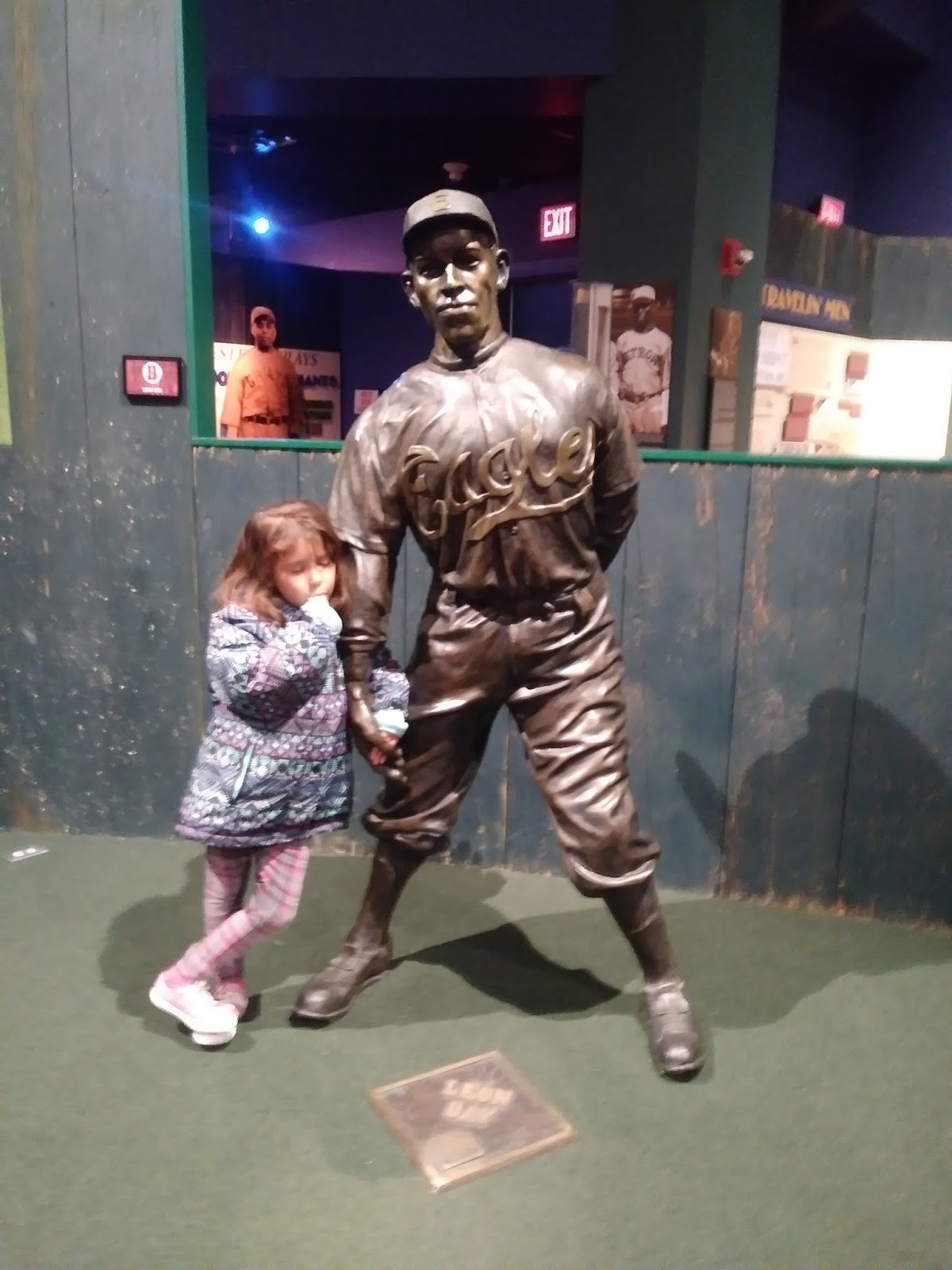
For decades there was no uniformity in compensation. Players on the winning squad would split the take from ticket sales with the venue, and the loser went home hungry. They would play doubleheaders in almost every town, sometimes even more than that. Even winning didn't gaurantee pay. Even pay didn't gaurantee food or accommodations. It was a life lived on the road, not just out of neccesity of schedule, but because of hostile environments for black men during Jim Crow. They were forced to develop of a kind of Underground Railroad, a network of businesses and families known to help.
Knowing that their performance was their pay, these players developed a hard-nosed but flashy style of play. The more butts in seats, the more take home pay at the end of the game. Satchel Paige would be the most notable of larger than life characters, famous for his taunting behavior towards opponents and interactions with fans, but he was far from the only one. The entire league played fast and pretty in the field and on the base paths. You couldn't just be good. You had to look good, too. This extended to the clothing the fans wore to ballgames, dressing up in their Sunday's best for each game.
I grew up hearing stories about players like Cool Papa Bell, Roy Campanella, Josh Gibson, Minnie Minoso, and Double Duty Radclife from my grandfather who used to go to Monarchs games when Municipal Stadium still stood at 22nd and Brooklyn. As a kid, those stories made those guys sound like comic book superheroes.
One of the players my grandfather would talk about most was a pitcher by the name of Hilton Smith for the Monarchs. Hilton and Satchel Paige were the most feared pitching duo in either of the Negro Leagues. They were both tall, aggressive, multi-tool pitchers. Satch became the famous one for his antics on field, but he could be taken advantage of that way. Hilton was a quiet man, all business, and very hard to find a weakness in. Hilton Smith was instrumental in the Monarchs dominance, but even today he remains a very little known name, despite having possibly the best record in Negro Leagues history. (Statistics were never properly kept, but what we do have shows he rarely lost.)

Players would supplement their meager incomes by playing exhibition, or barnstorming, games. This eventually lead to the export of players to Central and South American countries during winter months. To begin, the Negro League players were paid much less than their white MLB counterparts in these Latin Leagues. Simply because they knew the Major Leaguers there. Before long, the black players began to show they were worth the same pay, and they got it. Think about that. These men had to leave the country just to get the same pay and food as the white players they proved they could beat back home in exhibition games. Check the qoute in the picture for an idea of how differently they were treated South of the border.

Countries like Mexico, Cuba, and Venezuela became hotbeds of baseball talent, attracting the best white and black American players, professional Latino players, and even professional players from Asia, all playing side by side. This undercurrent of talent is what lead to desegregation in the MLB. Certain owners and managers began recognizing the talent at home and abroad. Latino players actually integrated first, but they were always light skinned and usually had their names changed. But those superficial restrictions needed to fall if owners really wanted to win ballgames and cash in. The games played in South America remain the stuff of legend, but it is often glossed over. This museum does a terrific job of explaining this era and it's value to the development of the game.
Monday, April 9, 2018
Bonus 9: Who Has the Right? - Brandon Ince
I've never felt more like a super villain than when articulating my thoughts for one of these bonus questions, this one in particular has me feeling especially rancorous. It is my belief that anyone has the right to write about any subject for any reason and that the burden of responsibility to dignify any particular work falls on the audience. The idea that a work would be determined to be not valuable due to a predetermined set of circumstances or elements that do not have anything to do with the document itself is fallacious at best. What matters is the prose, not the author's personal relation to the subject matter, any assertions to the contrary would be an avocation for a form of discourse censorship which will only hold us back in the end. In order to become a stronger society we will have to allow all voices to have the right to write/speak on all topics, and at the same time we must as an audience acknowledge the responsibility - nay, the necessity of developing a critical eye to discern the soundness of the message.
I feel an obligation to expound on something I said in the previous paragraph, my assertion that censorship will hold us back. I am not saying that censorship in all instances and in every situation is bad, there are certainly times in which withholding certain information is appropriate. Most of the time this is when the specific audience is not 'ready' to be exposed to such information, namely children with something like the horrors of war, or other 'R-rated' material. What I am saying is that within the context of well-to-do adults, the defensive embargo on certain perspectives within a forum of discourse is both immature and destructive.
The first amendment is a wonderful thing, it allows all a freedom to speak and it provides all who listened an idea to criticize. The very point of putting an idea out there in the first place is to have it dignified, sometimes through praise - often through criticism. There exists an ebb and flow between idea and criticism and discourse it provides, and with each cycle a society grows more defined and stronger. If one wishes to preemptively condemn a certain perspective outright, then they rob the rest of society from the potential cycle of discourse and thus prevents a perfectly good learning experience. If there is a speaker who hates, let him hate in the same way as if there is a speaker who loves, let him love. All voices have value if not within the content of their words then the experience of defining their message.
I almost feel as if those with firsthand experience with the topic are all the least qualified to speak. Their authority is informed by mere happenstance not distinction. The only thing they would be suitable to author is a low level firsthand account or meaningless memoir. Whatever sort of opinion or editorial they would pen would most certainly be compromised by their experience, which is at the end of the day - a very small world picture.
Sunday, April 8, 2018
Bonus 9, Who Has The Right? by Jared Islas
This particular question is quite tricky. In fact, it is so much on my mind that there have been some instances that I personally feel uncomfortable responding to a prompt or even commenting on a subject because I don’t feel like I have any knowledge or connection to the issues being discussed. This probably has more to do with my personality but I think it is something that a lot of people might feel the same way about.
Looking at the concept outlined in the prompt for this bonus, I don’t think that it is or was okay for this woman to write a story about a child with physical deformities based off of her and her children’s brief experience with another child. However, I do wonder if the woman who wrote the story and ultimately sold the film rights to her story did so without ever talking to families, children or medical professionals that were directly affected by this disability or similar ones. I think that this is an extremely important question that would certainly make R.J. Palacio, the woman who wrote the book’s, story more credible and easier to accept her as an author of this story.
I briefly searched the internet for any instance of Palacio mentioning if she had been in discussion with people directly associated with the disability and disappointingly couldn’t find any concrete answers. I want to believe she has because otherwise it would be a bit concerning considering this book is extremely popular and Palacio profited off of not only the original Wonder book, but also 3-4 more of her books which focus on the same characters and disabilities, AND the film based off of her book. In an interview with NPR, Palacio did say that after writing Wonder, she has become “an advocate for children born with craniofacial differences.”
Obviously not every single person who experiences something worth retelling in a book or movie is interested or “talented” enough to be able to write their story for a wider audience. Therefore, I see the necessity for proven authors and screenwriters to write these stories for these people. My only stipulation would be that these authors and screenwriters must have some connection to the story they wish to write about. I would hope that they would be able to speak to the person, people or people related to or close to the person whom the story is being based off of. This would give them not only a personal connection to the topic they’re writing about but also give them the opportunity to ask questions about the topic to a real living subject rather than information they found just from research.
In a piece for the New York Times, Anna Holmes discusses this topic by comparing empathy and exploitation but also says that, “Sometimes empathy and exploitation find expression in the same place.” I think that this perfectly sums up my views on this issue. Her books and movie may be telling an empathetic story but no matter what way you look at Palacio’s scenario, she has become who she is today, and profited, off of a child with disabilities.
Sources:
Friday, April 6, 2018
Bonus 9 by Kyra Moore
The
concept of “second hand” story telling has always been skeptical and an uneasy
topic for me as well. I too battled with discerning with who was “able” to
speak on certain topics and/or events that are transpiring or have transpired.
For example, if there was a writing composed by a white man who spoke of the
times of the Cherokee removal-is it his right? This is easily comparable to the
example given in the prompt but also to work(s) that we have discussed in
class- the poems of Sherman Alexie are a perfect example. He was an “outsider,”
so to speak, but he was immersed in a marginalized culture.
This
is something that I mentally battled with until I came to a concrete consensus
on how I felt on the matter. Actually, the readings that we have read in class
and the conversations about the matter actually helped me sort out of my feelings
pertaining to the matter. I now have a consensus about how I feel about “outsiders”
speaking on events that have not happened within their particular culture.
While
I do feel like the perspective of the marginalized people should be most
respected as it is the most authentic, I also feel as if every perspective or
angle of an event or issue should also be respected. I feel that there is value
in differing perspectives pertaining to a matter if it is conducted in a
respectful manner. If everything is done with respect for the event and the
people involved, I could definitely see there being a benefit. Using Sherman
Alexie as a perfect example, his works are very respectful of the cultures that
he worked with and almost look at those cultures in reverence, so to speak. One
of the reasons why I praise Sherman Alexie and his work is because he
intentionally chose to immerse himself in a number of cultures. I think that
should be a requirement of those who choose to speak of specific events.
Using
the example of the child with facial deformities in Wonder, I feel as if the author is justified in writing the work
that she did. She was affected by something that she actually witnessed and saw
the injustice and wrong behavior surrounding the event, so she felt so inclined
to write about it. In reality that is what I think art and freedom of speech
is, talking, writing or producing art that is meaningful to you- especially if
it promotes actions meaningful to the greater good.
These
examples are a testament to the current philosophy that I now have on the
matter- respecting all perspectives that are made in respect to the event and
people involved. I actually feel that there should be more works like Wonder and Sherman Alexie’s poems. This
could potentially change the tone of literature and also change the tone of
social interactions as a whole.
Overall,
while the voice of the oppressed is very powerful, other voices that have good
intentions but different perspectives should also be respected and appreciated.
Monday, March 26, 2018
Bonus 8 - Midterm Check Up - Brandon Ince
I am losing steam. Opinions are beginning to become harder to
formulate and defend, assignments are harder to keep track of, work
conflicts with study and I still haven't made enough to pay off tuition.
The amount of pint up stress and dread and the notion of having a
relaxed final college semester is neigh irreconcilable. When time is
spent doing one assignment I regret not spending that time doing another
assignment, when I switch over to the other assignment I wonder why I
didn't even finish the first assignment causing an equal amount of grief
and distraction - thus the cycle of building tensions begins. All
things considered, I am a wreck. But with this first bonus point blog
post I hope to break this cycle of doing-in-vain and commit to doing
something that exceeds expectation instead of simply what is on the
docket - a "bonus" if you will. Before your very eyes I will lay out my
"All American 3 Step Plan to the Betterment of Body, Ethic, and Spirit."
(Though it's not necessary that every step betters each virtue all
together, like a toddler its best to take it one step at a time.) The
goal is nothing as concrete as "loose twenty pounds by May 9th", but
simply to feel like a better person on my own terms, in my own way - by
May 9th.
All American Step #1 - Low Carb Diet
I am a sloth. The only form of honest exercise I get every week is the long and incredibly arduous climb to the Education Building second floor for my lovely Discourse 300 class, both the class and the stairs leave me winded, but both are worth it. However, seeing how I'm typically a stagnant human being, carbs are my worst enemy for keeping healthy and beautiful. Spaghetti may be tasty and there may be nor greater pleasure than crackin' a bag of home-style original Lays, but if I'm not planning to run any marathons - or at all actually- then those treats best stay on the shelf. It takes a certain kind of lifestyle to sustain an intimate relationship with the bottom portion of the food pyramid and that certain lifestyle is a foreign to me as French prose.
All American Step #2 - Be Inconvenient
Convenience is the root of anxiety. The most dangerous habit I have formed over the years is orienting my schedule to allow me the most amount of uninterrupted rest along with the least amount of work. This method of lifestyle min/maxing is an awful thing to get used to. For me it has engendered an irresponsible amount of procrastination and an influx of low quality/effort work. I know if I am allowed to continue on like this I am bound to collapse - collapse under the stress induced by my hedonistic style in "taking it easy". Instead of fixating on the delights of lethargy, try finding the joys of superfluousness and discomfort. Exercise, which is lauded by intellectuals across the land, is - after all - quite uncomfortable.
All American Step # 3 - The Little Things, baby.
Oh what happiness can be found in the little things. Someone once said, "From a blade of grass one can learn 500 lessons" This open minded mentality can lead to lots of things, a better consciousness both social-wise and academically, a greater sense of appreciation for most things, and if you forget your phone in the bathroom then its a great time sink.
Subscribe to:
Posts (Atom)
-
 The Pirates of the Caribbean: The Curse of the Black Pearl was the first of a now popular series. It romanticized pirates' legend...
-
 The 2008 Marvel movie IRONMAN is a movie about a brilliant American industrialist Tony Starks, performed by actor Robert Downy Jr, who ...
-
 We have a lot of Modern social issues in society that need to be overcome. Drugs, violence and peer pressure are extreme concepts that...