Perspective has always been a major
aspect within communicating a message. Whether it is a movie, a novel, or an
article in a newspaper, perspective takes on one of the most important roles
for making a message understood. It’s an Honor by Jimmy Breslin is no different. Within the story, Breslin uses Clifton
Pollard to represent the common people. However, “in the past, journalists have
always focused on just a small range of sources when gathering information for
their stories. Most attention went to elite actors, while ordinary citizens
were judged of minor importance resulting in only a few common people being
mentioned in news output” (Keyser). The focus on the elite makes it harder for
a common person to be able to relate to the issue trying to be presented, especially
if it is an issue of great importance that revolves around a select few elite. Breslin’s
use of perspective takes a major issue such as John F. Kennedy’s death and
makes it more personable and relatable to the common people. This article not
only conveyed the people’s distraught for John F. Kennedy’s death, but also illustrated
their love for the man through the reverence of the dirt in which he was to be
buried in and the honor that it was to for Clifton Pollard to dig his grave. Usually
one of the few times that the common man is used as a source of information is “when
an ordinary citizen serves as a spokesperson for a civic movement consisting of
his peers. Especially when such a group of citizens is critical of an elite’s
decisions or behavior, the person voicing dissatisfaction is a welcome source”
(Keyser). Through the basic use of the common man, journalist can manipulate
the view point to tell the story that they wish to be shared while satisfying the
need that could be perceived by common people to have their voices heard.
Breslin gives another perspective that the audience receives is that of Jackie
Kennedy, the wife of John F Kennedy.
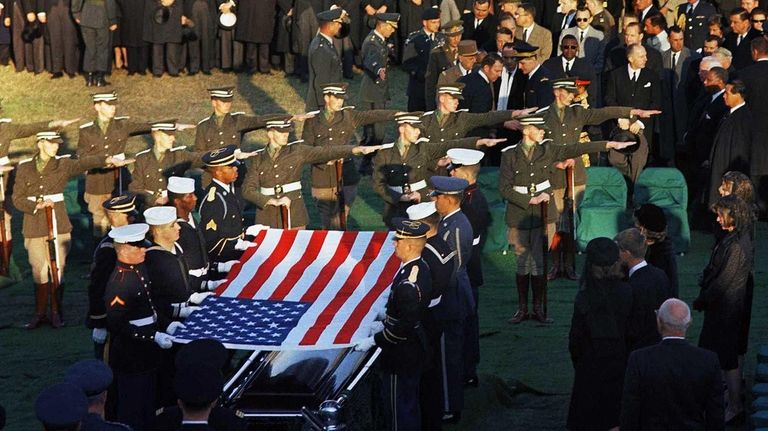
It would have been most popular to
write about Jackie Kennedy, her reaction, and how strong and sad she must be to
have lost her husband. However, she took up but a small part of the article. A
small excerpt from the article shows this, “Everybody watched her while she
walked. She is the mother of two fatherless children and she was walking in to
the history of this country because she was showing everybody who felt old and
helpless and without hope that she had this terrible strength that everybody
needed so badly. Even though they had killed her husband and his blood ran onto
her lap while he died, she could walk through the streets and to his grave and
help us all while she walked” (Breslin 468). Within this article her importance
is shown, along with her strength and her duty. Nevertheless, the main
perspective from the story was that of Clifton Pollard. Through Breslin’s
writing the audience can see that “the demand to contact an elite source in
every case is weakening (Brennen, 2009), decreasing the elites’ power to
control the news agenda (Bivens, 2008), but the basic societal structures
remain unchanged in substance (Fuchs, 2009). As a result, citizens may have
gained more importance in the news output, but they remain rather unimportant
as actors even in the current context (Dimitrova and Stro¨mba¨ck, 2009)”
(Keyser). Rather than being important, being strong, and having a duty to the
people, Pollard was characterized as being nothing more important than your
common man. He was shown as a simple worker that had to work an extra day, but
from his perspective the audience, of which the majority would be common people
like Pollard, can see the honor felt by the man towards being involved in the
burial of the fallen President. From the article the audience is shown that “Clifton
Pollard wasn’t at the funeral. He was over behind the hill, digging graves for
$3.01 an hour in another section of the cemetery. He didn’t know who the graves
were for. He was just digging them and then covering them with boards. ‘They’ll
be used,’ he said. ‘We just don’t know when”’ (Breslin). Pollard was not
allowed at the funeral as he was not important enough. That did not change the
love and respect that Pollard felt for the dead President, rather it showed the
situation that most common people were in. Their world could not stop to grieve
for the fallen man despite their love and honor felt for John F Kennedy. They
had to continue to do their jobs even if they were like Pollard and had no idea
or control.
Perspective has been and shall
always be a major influence on the understanding of ones writing. By forming the
connection with the common people from writing from the point of view of a
common man, Breslin was about to relate back to his target audience. By not
writing from the view point of a person from the elite, Breslin was able to
communicate the grief, love, and respect that common people like Clifton
Pollard felt when mourning John F Kennedy. If he had written the story from the
point of a person of the elite, then the affect would have felt almost forced
because of the duty and strength that the elite are generally assumed to have.
Sources:
Breslin, Jimmy, and New York Herald Tribune. “Read Breslin's Signature 1963 Column about
JFK's Gravedigger.” Newsday, Newsday, 20 Mar. 2017, www.newsday.com/opinion/digging-
jfk-grave-was-his-honor-jimmy-breslin-1.6481560.
De Keyser, Jeroen and Karin Raeymaeckers. "The Printed Rise of the Common Man." Journalism
Studies, vol. 13, no. 5/6, Oct. 2012, pp. 825-835. EBSCOhost,
doi:10.1080/1461670X.2012.667993.
Kerrane, Kevin, and Ben Yagoda. The Art of Fact: a Historical Anthology of Literary Journalism. Simon and Schuster, 1998. It's an Honor By: Jimmy Breslin


