Sunday, April 15, 2018
Museum Bonus: Alex Giangreco
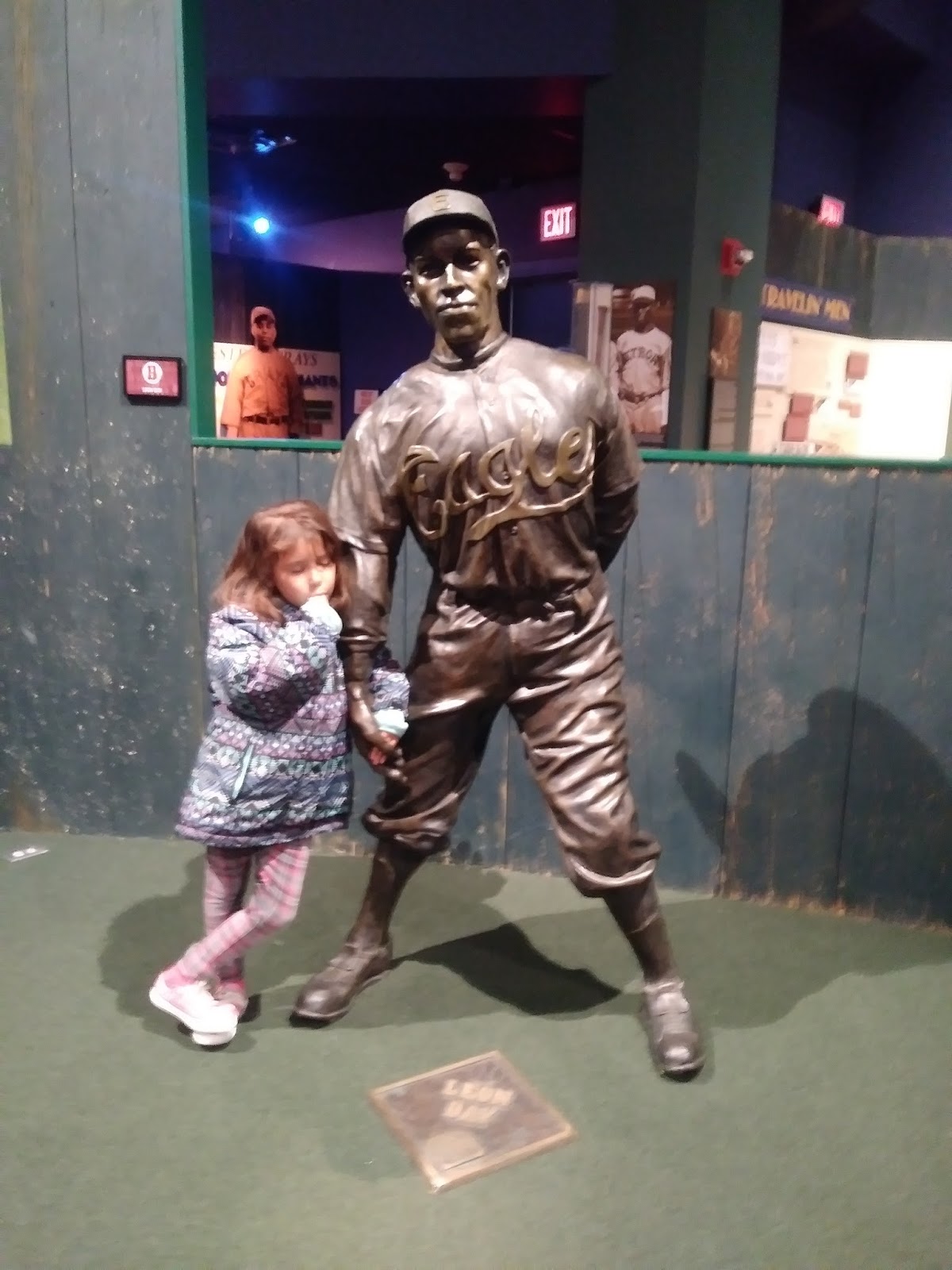
I visited the Negro Leagues Baseball Museum in the 18th and Vine district, because I have a membership and that made this post a no-brainer. One of my major interests is baseball, specifically baseball history. The most fascinating era of baseball for me is the Negro League era, for two reasons. They played a style and brand of baseball that is unique to that time and circumstance, one that would change the game at the Major League level forever. They played for the love of the game, and nothing more.
For decades there was no uniformity in compensation. Players on the winning squad would split the take from ticket sales with the venue, and the loser went home hungry. They would play doubleheaders in almost every town, sometimes even more than that. Even winning didn't gaurantee pay. Even pay didn't gaurantee food or accommodations. It was a life lived on the road, not just out of neccesity of schedule, but because of hostile environments for black men during Jim Crow. They were forced to develop of a kind of Underground Railroad, a network of businesses and families known to help.
Knowing that their performance was their pay, these players developed a hard-nosed but flashy style of play. The more butts in seats, the more take home pay at the end of the game. Satchel Paige would be the most notable of larger than life characters, famous for his taunting behavior towards opponents and interactions with fans, but he was far from the only one. The entire league played fast and pretty in the field and on the base paths. You couldn't just be good. You had to look good, too. This extended to the clothing the fans wore to ballgames, dressing up in their Sunday's best for each game.
I grew up hearing stories about players like Cool Papa Bell, Roy Campanella, Josh Gibson, Minnie Minoso, and Double Duty Radclife from my grandfather who used to go to Monarchs games when Municipal Stadium still stood at 22nd and Brooklyn. As a kid, those stories made those guys sound like comic book superheroes.
One of the players my grandfather would talk about most was a pitcher by the name of Hilton Smith for the Monarchs. Hilton and Satchel Paige were the most feared pitching duo in either of the Negro Leagues. They were both tall, aggressive, multi-tool pitchers. Satch became the famous one for his antics on field, but he could be taken advantage of that way. Hilton was a quiet man, all business, and very hard to find a weakness in. Hilton Smith was instrumental in the Monarchs dominance, but even today he remains a very little known name, despite having possibly the best record in Negro Leagues history. (Statistics were never properly kept, but what we do have shows he rarely lost.)
Players would supplement their meager incomes by playing exhibition, or barnstorming, games. This eventually lead to the export of players to Central and South American countries during winter months. To begin, the Negro League players were paid much less than their white MLB counterparts in these Latin Leagues. Simply because they knew the Major Leaguers there. Before long, the black players began to show they were worth the same pay, and they got it. Think about that. These men had to leave the country just to get the same pay and food as the white players they proved they could beat back home in exhibition games. Check the qoute in the picture for an idea of how differently they were treated South of the border.
Countries like Mexico, Cuba, and Venezuela became hotbeds of baseball talent, attracting the best white and black American players, professional Latino players, and even professional players from Asia, all playing side by side. This undercurrent of talent is what lead to desegregation in the MLB. Certain owners and managers began recognizing the talent at home and abroad. Latino players actually integrated first, but they were always light skinned and usually had their names changed. But those superficial restrictions needed to fall if owners really wanted to win ballgames and cash in. The games played in South America remain the stuff of legend, but it is often glossed over. This museum does a terrific job of explaining this era and it's value to the development of the game.
Thursday, April 12, 2018
Bonus 9: Who has the right? By, Weini W.
I feel like everyone has the right to
write about anything. But in my opinion when it comes on writing tragedy
events, anyone who have a good intent and had made research thoroughly can
write tragedy events. It is
undeniable for us to want to hear the story from those who were actively involved or who saw the
tragedy happening on firsthand in order to relate or to know what the tragedy feel likes. But the reality is, those people who were in the tragedy
might not have the knowledge on how to write and the ability to put what they
went through in words. This might result for the tragic events on remaining
untold. Those people who go out on their way to meet up and learn what went on,
might be able to hear the story from the people life experiences. Those life experiences
are the fuel for authentic and powerful writing. Those people who put their
self in new, even challenging situations absorb and understand different types
of people and this may result in building the readers empathy muscle. Life may
sometimes imitate art, but more often, life inspires what humanity and meaning
of life is.
If we look at the discussion we had in
class where the story provides the structure for narrative flashback and
personal commentary “The Third winter”, the author Martha Gellhorn visits and interview
a family in Barcelona. If we focus on whether she had the right to write the
tragic event or not, I would argue that she does. At that specific period of
time the people who were suffering from the war, their voice could only be
heard through a third party who have been watching what they have been going
through and that is what the reporter Gellhorn did at the time. Even though she
wasn’t suffering as much those people did in first hand she was able to show
the readers what their situation was and that they were living with hope and
faith.
In my opinion those people who have the right to write are those people who read
widely beyond the confines of their subject or genre, watch film and television
in a variety of genres – fiction and non-fiction, listen to talks and podcasts
on a wide range of topics and have a clear knowledge of the tragic events. Those
unusual influences will make their writing stand out since they have
a good intent and research it thoroughly. There might be times where those tragic events might not be acceptable
by the readers due to the lack of putting all the detailed information. But the
bottom line is those stories need to be told. If we have to wait for those people
who were actively involved or who saw it first hand, the
story will remain untold and people might end up not knowing what people had
gone through. Those tragic events need to be told in a right way in order to
get the justice and peace what any human being deserves.
Wednesday, April 11, 2018
Bonus 9: Who Has the Right? -Sam U
I also struggle
with this topic and I ultimately come to accept that works such as Wonder are necessary to understand the
differences of people across all cultures or circumstances. Story telling may
contain many truths, lies, exaggerations and censored or uncensored content. Writing
novels on sensitive topics is more than likely a huge responsibility that is
assumed by one person and a hard task to accomplish. As readers, it is our own
responsibility to interpret these stories as we see best because only the
authors themselves truly understand the motives and feelings they are trying to
convey behind every sentence/scene.
Even if authors
attempted, they simply cannot tailor each and every single one of their stories
to fit or ‘please’ every one’s sensitivity spectrum or point of views. This may
seem a bit harsh but in the end, I believe anyone is entitled to say or feel
whatever they like. Authors tend to go based off of their own research, feelings
and experiences. Therefore, it is easier to have an open mind and try to
understand where they are coming from as opposed to disputing it all. Their
works should be respected for what they are even if you don’t agree. Whether
they are factual, non-factual, valid or not valid it is solely up to ourselves
to pick our truths. Just like no one can actually live a day in another person’s
life– we can try to empathize much like the authors do.
Authors
understand that mass criticism is a consequence of publishing novels and
directing movies. If their work was socially acceptable or not, it doesn’t change
the fact that it was already created. Certain things I come across do upset me
but I try to brush it off and continue my search of what is morally right for
me and my set of values. I also try to remind myself that it isn’t the first or
the last of its kind. New movies and books are written every year! I simply
cannot taunt my entire existence due to a piece of work I didn’t find myself to
agree with.
It is certainly
saddening to see how some stories are taken, misrepresented and unfairly told but
that is only one voice. Allow me to further explain, I am not trying to justify
anyone for any reason but there’s plenty of other authors and voices patiently
waiting to be discovered. Hopefully, learning from previous authors tackling similar
subjects with the intention to improve and encourage honest pieces of work.
Furthermore, to account for all the bad works we should encourage only those
who aim towards telling truth. Not every piece of work needs to receive attention
or recognition. If it is badly constructed the numbers will show.
Overall, as individuals we all have
differences. No one and everybody has a right to tell a story of another
person. Freedom of speech allows everyone to have their own voice and this is
very powerful because we can’t essentially change or regulate what authors
decide to do within their stories. They will
continue to do so regardless if we think they have the right or not to
tell the story of another person.
Bonus 11 - What's so Funny? by JJ Leath
Humor is really quite strange. While there may be many
theories on what makes something funny, there really can never be a solid
definition of what makes something funny and what is acceptable to joke about
because both of these are unique to every individual. What I believe makes
something funny comes down to the unexpected happening, and what is acceptable
comes down to context, who is saying it, and who he is saying it to.
First, what
makes something funny at all? In the question originally posed, it is stated
that “Humor usually violates personal norms that tie into cultural norms. For instance, fart jokes.” I think there is a
lot of credence, but I don’t think that this is the very thing that makes
something funny. For instance, consider puns. These are not funny because they
go against cultural norms. These are funny (to some people) because they use
words or phrases in unexpected ways. Further, consider Trevor Noah’s end to the
“black Hitler” bit. This was funny because he previously mentioned wanting to
be black, so when the German yelled “black Hitler!”, Trevor ended the bit by
saying “at least she said I was black.” That’s hilarious. I would call this
clever humor. You didn’t expect that to be what he said after this encounter. I
think that if you were to boil humor down to its essence, I think it is just
when something happens or is said that you didn’t expect. This explains why
personal or cultural norms being violated is funny – you don’t expect it. It
also explains why seeing someone fall down or stub their toe is funny – you
expected them to walk with no issue, but issues arose regardless. Humor is a
response to surprise similar to shock.
Secondly,
what makes something okay to joke about? I think this comes down to three
things: context, who is saying it, and who it is being said to. Consider
Gabriel Iglesias’ bit about the “racist gift basic.” The context was a comedy
show, so this is pretty harmless. Imagine, however, if he was speaking at the
funeral of a black individual killed by white supremacists. The same thing said
by the same person is no longer funny. With the same skit as an example,
consider if Gabriel was a white man. I think that the audience would have
thought it to be less okay. Because Gabriel is a minority himself, even though
he’s not black, it is likely to go over better. This comes down to the history of cultures. There is a history of white people being
oppressive towards black people, so further oppression is not going to be
funny. The Hispanic and black community do not have the same scarred history.
Finally, who you are saying the joke to is going to influence what is okay to
joke about and what is funny. If you tell a joke that is about how stupid Trump
is, it would probably go over well with the audience at the Democratic National
Convention. However, it would likely offend many and be unfunny to the audience
at the Republican National Convention. Your audience matters as well.
There are a
lot of variables into what makes something funny and what makes something okay
to joke about. These variations create a broad spectrum of comedy. You have
comedians using all types of comedy (clever tie-ins, clever social commentary,
puns, or “fart jokes”) appealing to all types of audiences. John Mullaney’s dry,
story-telling comedy is vastly different than Daniel Tosh’s extremely crude,
offensive comedy. Both are professional comedians, but an audience member of
one comedian’s crowd is probably unlikely to think the other comedian is very
funny at all. There will never be a formula for what is funny, there will never
be a strict definition. And in a world where most things have definitions and
in a world governed by the formulas of physics, this is unexpected. Isn’t that
funny?
Bonus 10 - Game of Thrones and Rape by JJ Leath
Bonus 10
I have not
watched the show Game of Thrones, but
I have read the books. The books are brutally violent, and there is a good
amount of sexual violence. I have never gotten the notion that Martin was using
this violence for cheap shock thrills, however. As Martin said in the quote
given, these books show realistic depictions of human travesty against other
humans. I think that this is the main theme in Game of Thrones. There are
monsters and supernatural enemies, but the acts of terrible villainy are done
by humans. This is important social commentary that Martin is making, and I
agree with Martin’s use of it in the books. However, I disagree with the film
adaptation’s likening of these acts to pornography.
If you
compare Game of Thrones to The Lord of the Rings, I think that Martin’s
social commentary really shines through. At the surface, Game of Thrones and The Lord
of the Rings are very similar series. The message is vastly different,
however. The violence in The Lord of the
Rings is minimal in comparison to Martin’s epic. There is absolutely no
sexual violence at all. Humans are the “good guys”. To quote Martin, “orcs and
dark lords” are the bad guys. The Lord of
the Rings is a story about the human spirit (or Hobbit Spirit, but for all
intents and purposes, Hobbits were analogous to humans). It is a story about
how the goodness of Man can overcome any evil. It is a feel-good story that
largely romanticizes war.
Game of Thrones, however, does not
romanticize war. All of the retched things that have plagued humanity’s history
are graphically depicted. People do horrible things to other people. But this
is exactly the point – monsters are not found in fairy tales, they are found inside us and are entrenched in human history. To exclude sexual violence would be to inaccurately describe war, and the commentary on the human condition would be diminished. As my only experience with the series has been the books, I can speak for the books that the sexual violence is used for a deeper purpose than cheap tricks or titillation. However, from what I know about the show, it seems like it does use the brutality for cheap tricks and it does sound like it exploits the actresses to simply use their bodies to attract a heterosexual male gaze.
The film adaptation of the series has perverted many of story lines from the book in my opinion. The gruesome acts done in the
books, the disturbing incest, and the sexual violence against women has
seemingly been turned into soft-core pornography. From the articles, it seems
like one of the most highly sexualized characters is Daenerys, who in the books
is a child. That is definitely concerning. I think that this is just further commentary on humanity. We might not be as evolved as we think.
Post 4 Group B- Sound of Music and the Perfect Wife ~ Dianesa Sanon
The Sound of Music is a movie based on a real-life story of the Von Trapp family living in 1930s Austria with war looming just around the corner. It released in the 60s and is, in a way, a product of its time and a romantic historical film. The war that is only hinted at in the beginning is made more obvious towards the end of the movie. The father of the Von Trapp family is a widowed strict navy general of seven unruly children. A nun, Maria, is introduced to the family and despite their rocky start the children start to love Maria who also finds herself in love with the Captain who in turn is falling in love with her but he is engaged to a Baroness who eventually makes herself sparse and Maria wins the heart of the Captain and they get married. All the while the Captain is being encouraged to fight in the war with Germany against his home and eventually the family, quite literally, runs for the hills.
The Sound of Music highlights what the ideal wife is supposed to be like. This movie, in my opinion, is more about Maria’s nurturing and loving personality. The war is a component to but it is just used to the support Maria. The film follows the optimistic and bright young woman fresh from a nunnery whose faith in God is as important to her as it is being kind to every person she come across. Throughout the film we can see how she manages the children, is slow to anger, is resourceful and is small and innocently beautiful.
Maria’s bright personality and optimism is a big a part of why the Captain and his children fell in love with her. She could turn thunderstorms into a list of pleasant things, she could turn a day into town a music lesson, she could keep the children orderly while the Captain needed his space to do his military stuff. Maria is presented as the buffer that subdues the catalyst. She is the epitome of what a good woman is. In every other scene her display of compassion and nurturing hardly ever falls short.
In the 60s women were expected to be well rounded in taking care of not only then home but the children as well. In the movie she’s met with the task of taming seven children who were so horrible they ran away all the other nannies that came before her and not only does she gain their trust and affection she sings her way through it all like some type of Disney princess. She even teaches the children a couple of songs that they sing to entertain the Captain, the Baroness, and a houseful of guests.
Tuesday, April 10, 2018
Post 4, Group B: Fear of Failure and By Jacob Bothell
This weekend I returned to Wichita in order to work with the production company that I have been a member of for 2 years now. The event was a mixed martial arts fight (MMA) at the Kansas Star Casino just south of Wichita. I had somewhat of an odd experience in this particular journey that I have not had in quite a long time: the fear of failure. This fear was odd for me. I am not sure why this particular event made me feel this way, but it did and I would like to understand more about why and attempt to not have that again... because it makes my job REALLY difficult.
What was it that a stage tech veteran (approaching 10 years) would feel anxiety about? Well this particular show I was to be running 2 jobs that would have me in 2 separate worlds of the production environment; the first was the job of audio for video, and the other is being a PTZ camera operator. The job of audio for video is where I sit in the video trailer and mix/produce the audio that people watching the live stream or pay-per-view hear. This job honestly on its own is exceptionally boring because once everything is setup all there is to do is maybe make adjustments during a video playback or if an announcer gets excited or if you want to make a moment emotionally interesting. The other job takes full attentiveness of the event and what and where the action is happening, and the interesting part of this particular job because it is a PTZ (pan, tilt, zoom) camera I am operating it remotely a.k.a. I am probably 200 feet away from its perspective and am not even in the same room as it which makes situational awareness difficult. So my only info on what is going on in the room is from my and the other cameras... very limited.
Combining these 2 jobs is actually much more difficult than it may seem; because while I am trying to frame up a shot that the production manager wants I am also attempting to make sure that the audio for the people that are not at the event is still engaging and informative. The interesting part of that is that the times that concentration is required for both of those tasks is exactly the same. For example, think about while 2 boxers are going at it and one begins to corner the other and more or less finish the fight. This is the emotional climax of the action and as such the audio should reflect that (turn up the ambient mics to hear the crowd/ring sounds and keep the announcers levels in check), and by golly the camera should never be pointed away from the action because you never know when your camera will have "the shot."
So I think that I am beginning to understand why my fear of failure began to emerge in this context. It is not because of some sort of stage fright, and I don't think it was because the job was crazy intimidating (mainly because I knew what I would be doing when I agreed to show up). I do think that it was because the job pulled me in a multitude of directions, that while being used to being aware of and being able to be critical of and fix things if I had to, there were simply too many different facets of the job(s) at hand to be able to appreciate and refine enough of them to feel that I was doing an adequate job.
What was it that a stage tech veteran (approaching 10 years) would feel anxiety about? Well this particular show I was to be running 2 jobs that would have me in 2 separate worlds of the production environment; the first was the job of audio for video, and the other is being a PTZ camera operator. The job of audio for video is where I sit in the video trailer and mix/produce the audio that people watching the live stream or pay-per-view hear. This job honestly on its own is exceptionally boring because once everything is setup all there is to do is maybe make adjustments during a video playback or if an announcer gets excited or if you want to make a moment emotionally interesting. The other job takes full attentiveness of the event and what and where the action is happening, and the interesting part of this particular job because it is a PTZ (pan, tilt, zoom) camera I am operating it remotely a.k.a. I am probably 200 feet away from its perspective and am not even in the same room as it which makes situational awareness difficult. So my only info on what is going on in the room is from my and the other cameras... very limited.
Combining these 2 jobs is actually much more difficult than it may seem; because while I am trying to frame up a shot that the production manager wants I am also attempting to make sure that the audio for the people that are not at the event is still engaging and informative. The interesting part of that is that the times that concentration is required for both of those tasks is exactly the same. For example, think about while 2 boxers are going at it and one begins to corner the other and more or less finish the fight. This is the emotional climax of the action and as such the audio should reflect that (turn up the ambient mics to hear the crowd/ring sounds and keep the announcers levels in check), and by golly the camera should never be pointed away from the action because you never know when your camera will have "the shot."
So I think that I am beginning to understand why my fear of failure began to emerge in this context. It is not because of some sort of stage fright, and I don't think it was because the job was crazy intimidating (mainly because I knew what I would be doing when I agreed to show up). I do think that it was because the job pulled me in a multitude of directions, that while being used to being aware of and being able to be critical of and fix things if I had to, there were simply too many different facets of the job(s) at hand to be able to appreciate and refine enough of them to feel that I was doing an adequate job.
Subscribe to:
Posts (Atom)
Resubmissios Essay
Throughout this essay I will be discussing the skills that I need to work on with it being personal skills and skills that pert...
-
The Pirates of the Caribbean: The Curse of the Black Pearl was the first of a now popular series. It romanticized pirates' legend...
-
The 2008 Marvel movie IRONMAN is a movie about a brilliant American industrialist Tony Starks, performed by actor Robert Downy Jr, who ...
-
The Lottery by Shirley Jackson is a thrilling masterpiece created in 1948. This short story starts off by welcoming clear sunny skies, gr...


